

Chargeable weight is the figure air carriers actually bill you on: the greater of your shipment’s actual (gross) weight and its volumetric (dimensional) weight. Because light, bulky freight takes up space a carrier could sell to someone else, you pay for whichever number is larger.
In air freight, what you ship is not always what you pay for.
Behind every quote sits a single concept that quietly determines your cost, shapes your routing decisions, and, more often than most shippers realize, decides whether you’re being charged for the right amount of service. It’s called chargeable weight (CW). It sounds simple. It is, and it isn’t. And despite being foundational to the entire air cargo industry, it’s still widely misunderstood and frequently misapplied.
I’ve been working with this number for a long time. Back in 1997, I taught myself to program just so I could build a desktop calculator for chargeable weight, a calculation that takes about ten minutes by hand and fifteen seconds with the right tool. Nearly thirty years later, the math hasn’t changed, but the number of places it can quietly cost you money has only grown. Here’s what every shipper should understand.
Why chargeable weight exists
Aircraft are constrained by two things: weight and volume. The doors have to close, and the plane has to get off the ground. A light but bulky shipment can fill a cargo hold long before the weight limit is reached; a dense one can max out the weight while leaving space unused.
If carriers priced freight on a single dimension, they would lose money on half of their shipments. Charge by weight alone, and you give away space to anyone shipping feathers. Charge by volume alone, and you give away lift to anyone shipping batteries. So the industry settled on a simple rule: you pay for whichever is greater, your actual weight or your volumetric (dimensional) weight. That greater number is your chargeable weight.
Why chargeable weight uses multiple DIM factors
There’s no single universal way to convert volume into weight. Instead, the industry uses a range of DIM factors, cube-to-weight conversion ratios. The most common:
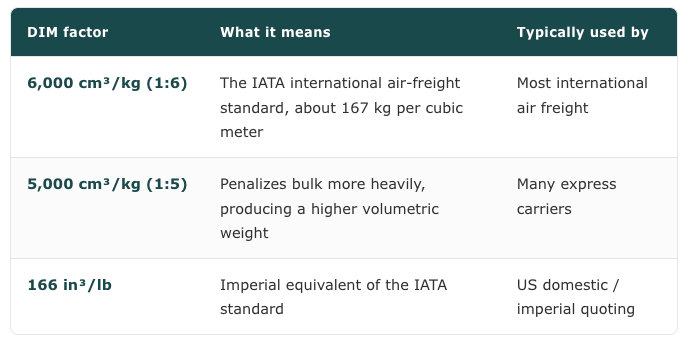
This isn’t inconsistency; it’s evolution. DIM factors shift as the industry recalibrates to what’s actually being shipped, and they reflect the leverage of whoever is negotiating. The factor you’re quoted isn’t a law of physics. It’s a term, and terms are negotiable.
How chargeable weight is calculated
At a high level, chargeable weight is calculated in three steps:
- Calculate shipment cube. Each carton is measured, rounded to the nearest whole unit per IATA guidelines, and multiplied out. Add the cartons together for the total cube.
- Convert cube to volumetric weight. Divide the cube by your DIM factor. (Worth repeating: that factor is negotiable. I’ve even seen discounted volumetric terms.)
- Determine chargeable weight. Take the greater of actual weight and volumetric weight, then round, typically up to the next 0.5 kg or whole pound. That final rounding can nudge a shipment across a pricing tier, which is a cost driver of its own.
Where chargeable weight mistakes hide
Two places, consistently.
- Rounding at the carton level. IATA allows carton dimensions to be rounded to the nearest whole number. In practice, some providers round up every time. Take a carton that measures 10.4 × 10.4 × 10.4 cm. Rounded correctly, that’s 10 × 10 × 10 = 1,000 cm³. Rounded always up, it’s 11 × 11 × 11 = 1,331 cm³, about 33% more volume. Same box, same contents, very different bill. Multiply that across a full shipment profile, and it stops being a rounding nuance and becomes a structural cost problem.
- Carton-level vs. shipment-level math. Calculating cube carton by carton versus rolling it up at the shipment level can produce materially different results. I’ve seen the same freight come out to 300 kg one way and 260.5 kg the other, roughly a 15% difference, with no change in rate and no change in service. Just different math.
When carriers change the chargeable weight rules
It’s not static, either. Carriers periodically adjust how they calculate volume, and some have moved from rounding to the nearest whole number toward rounding up. It sounds minor. It isn’t. Most US companies build their packaging in centimeters for international shipping but ship domestically in inches, which means the conversion almost guarantees you round up. The cost creep is automatic, and most shippers never see it.
See the chargeable weight math for yourself
This is precisely why we rebuilt our Chargeable Weight Calculator and put it online, free and open. Enter your shipment at the carton or summary level, and it shows you everything at once: actual weight, cube (CBM), volumetric weight across multiple DIM factors, and the resulting chargeable weight, so you can see precisely where your cost is coming from and check it against what you’re being billed.
If you ship air freight regularly, do four things:
- Validate how your providers calculate chargeable weight.
- Understand which DIM factors they apply.
- Confirm where rounding happens.
- Test your own shipments with an independent tool.
Run your own numbers: Acuitive Chargeable Weight Calculator

Chargeable weight FAQ
What is chargeable weight?
Chargeable weight is the weight air carriers use to price a shipment. It is the greater of the actual (gross) weight and the volumetric (dimensional) weight, so light but bulky freight is billed on the space it occupies rather than on what it weighs.
How is chargeable weight calculated?
Measure each carton and total the shipment cube; divide that cube by the carrier’s DIM factor to get volumetric weight, then take the greater of volumetric weight and actual weight and round up to the next 0.5 kg or whole pound.
What is a DIM factor?
A DIM (dimensional) factor is the cube-to-weight conversion ratio used to turn volume into weight. The IATA international standard is 6,000 cm³/kg (about 167 kg per cubic meter); many express carriers use 5,000 cm³/kg, and US imperial quoting uses 166 in³/lb. The factor is a negotiable term, not a fixed rule.
Why is my chargeable weight higher than my actual weight?
Because your shipment is light relative to its size. When volumetric weight exceeds actual weight, you are billed on volume. Aggressive carton-level rounding or a less favorable DIM factor can push that number higher still, sometimes by 15 to 30 percent on the same freight.